June 8, 2026
Making Your Code of Conduct Actually Work — Beyond Just Posting the Document
From “posted” to “functioning” — the typical patterns of CoC decay
In many communities, a Code of Conduct (CoC) becomes “done” the moment you create the page. You paste it into Notion, drop a link in the Slack channel description, include the URL in the signup form — and consider it finished.
What happens then?
- Operations stall when a violation occurs: Every incident triggers a fresh debate about whether this counts as a violation and what to do about it.
- Responses are inconsistent: Similar violations get different treatment depending on who handles them.
- Members cannot see it: People don’t know the CoC exists, let alone how to file a report.
These are not problems with the CoC’s content. They are operational problems. No matter how carefully the document is written, a CoC that is unread, unused, and never updated serves no function.
CoC decay falls into three typical patterns:
① No agreement process: There is no moment in the onboarding flow where the CoC is “read.” Members who discover it later have no sense of having agreed to anything.
② Ambiguous decision-maker and standards: The CoC does not state who makes judgment calls or what criteria apply. When a problem arises, the responsible person floats in a vacuum.
③ Never updated: A CoC written once is assumed to last forever, but as any community grows, situations arise that the original document never anticipated. Without a review cycle, the CoC gradually detaches from reality.
This article covers the operational design that makes a CoC work. For the items to include in your terms of service and guidelines (prohibited actions, disclaimers, copyright, personal data, etc.), see Community Terms of Service and Guidelines — Minimum Required Rule Design. For the wording itself — how to write guidelines that guide behavior rather than forbid it — see Designing Community Guidelines That Guide, Not Forbid. This article picks up where those end: making the document you’ve written actually function.
Design your CoC as three operational loops
The framework for making a CoC work: three loops.
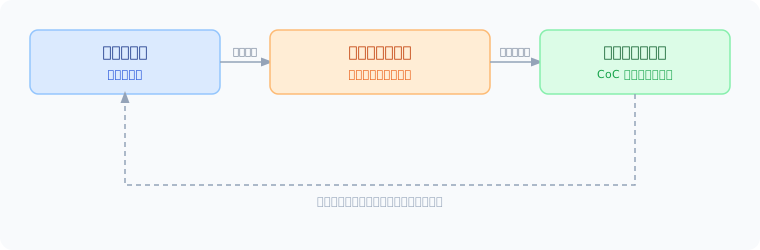
Loop 1: Onboarding Loop — design the moment of agreement
Collecting agreement at signup is not primarily a legal obligation (that belongs to terms of service). Its purpose is to create the fact that this community has behavioral standards and that the member joined knowing that.
Design elements of the onboarding loop:
| Step | Example implementation |
|---|---|
| Acknowledgment | ”I have read the CoC” checkbox on the signup form |
| Summary delivery | Send a “CoC in 3 sentences” message to new members via DM or welcome channel |
| Principles declaration | Operators share their vision for the community in the welcome channel |
Checkbox agreement vs. conversational orientation
A checkbox is easy to implement but easily reduces to a click. Conversational orientation — a DM or Q&A thread with the operator in the first week — requires more effort but is much more effective at making members perceive the CoC as relevant to them.
For communities under 100 members, try conversational orientation. Above 100, automated checkbox agreement plus a welcome message becomes more realistic.
Violation patterns most common in the first 7 days
Empirically, most community violations stem from a new member not yet knowing the context of the space:
- Multi-posting (same message across multiple channels)
- Promotional posts without context
- Stepping on unwritten norms that existing members take for granted
These come from ignorance, not malice. Communicating the context of the space during onboarding is the most efficient form of violation prevention.
Loop 2: Violation Response Loop — systematize judgment
The biggest failure mode in violation response is starting from zero every time. Systematize judgment using flows and records rather than individual discretion.
The flow from report to response
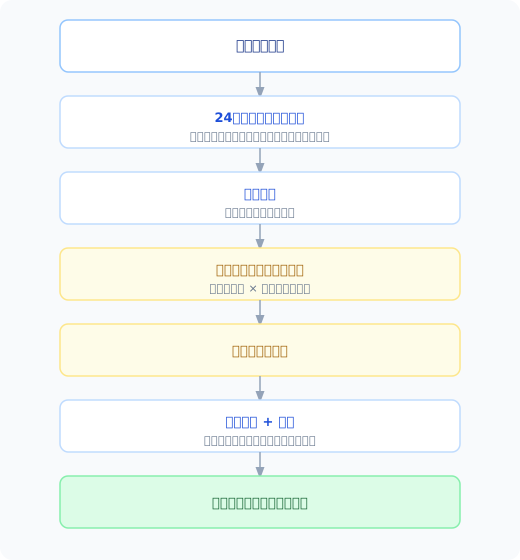
The severity matrix
Classifying violations on two axes stabilizes response levels.
| Isolated | Repeated | |
|---|---|---|
| Public (visible to others) | Caution or post removal | Warning → suspension |
| Private (DM, one-on-one) | Private caution | Warning → suspension → removal |
Public and repeated violations are treated most seriously — their cumulative effect on community culture compounds. Private and isolated incidents can be handled between the parties involved, but repeated behavior from the same person triggers immediate escalation.
The escalation ladder
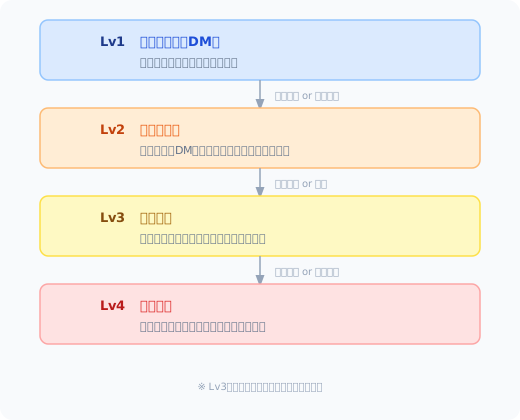
Define in advance the criteria for each level and where multiple-operator consensus is required. For example: “Lv3 and above always requires two or more people” or “removal requires approval from the operations lead.”
Recording the response
Document every violation response. Minimum fields:
- Date and time
- Violation summary (screenshots, etc.)
- Reporter (note if anonymous)
- Decision-makers (who)
- Decision content (what and why)
- Outcome (what was communicated to the reported party)
Records are a reference asset for maintaining consistency in future judgment. Being able to search “how did we handle a similar case?” improves both the speed and quality of decisions.
Loop 3: Review Loop — keep the CoC alive
Designing the quarterly review
| Review item | What to check |
|---|---|
| Violation log review | How many violations occurred this period? Were responses consistent? |
| Unanticipated cases | Any patterns that arose but were not covered by the CoC? |
| Add or remove | Any items that are missing or redundant in the current text? |
| Wording revision | Sections that should be rewritten to reflect cultural changes? |
In the annual review, ask: “If a brand-new member read this CoC today, would they understand the space correctly?” Long-running operators tend to accumulate “obvious to us” knowledge that never made it into the CoC.
Systems that prevent violation response from becoming individual heroics
The greatest risk in community violation response is full dependence on one operator’s judgment. Individual-dependent responses vary with the handler’s emotions, energy, and schedule. It also becomes difficult for the handler to be objective when they themselves are the target of harassment.
Consensus among multiple operators
Any response at Lv2 (formal warning) or above should be confirmed by at least two people. Rather than deciding unilaterally that “this is warning-level,” create the ability to ask a colleague: “I’m leaning toward this reading — do you see it differently?”
For small teams, having a trusted outside party — someone outside the community itself — whom you can consult is also valuable.
Maintaining a decision guide
Reconsidering “which CoC clause applies here?” and “what level of response is proportionate?” for every incident is exhausting. Build a decision guide (a FAQ-style response table) that covers common patterns.
Example:
Q: A member repeatedly posts self-promotional content. What do we do?
A: First occurrence: private caution (Lv1), requesting context be added to promotional posts. Second occurrence: check the violation log and escalate to a formal warning (Lv2).
Accumulating reference cases
Maintaining anonymized records of handled cases creates a reference library for future judgment. When new operators join, “here’s how we handled a case like that before” becomes part of the hand-off.
The revision process — bringing members in
Revising a CoC with only a “we updated it” announcement fails. The reasoning behind the change doesn’t land, and the abruptness breeds confusion and resistance.
Four things to include in any revision announcement:
- Before-and-after comparison: what changed, exactly
- Reason for the change: what event or problem prompted it
- What did not change: the principles that remain constant
- What operations will do next: how the team will act under the updated CoC
Where possible, consider inviting members into the revision process. Questions like “Are there any unclear points in the current CoC?” or “How do you think we should handle cases like X?” create participation in the process itself — which simultaneously deepens understanding and increases commitment to the outcome.
How much to make public — the public/private line for violation responses
When someone is removed or content is deleted, rumors form inside the community. Saying nothing lets speculation and anxiety fill the void. But disclosing all the details of every violation response risks harming the privacy of those involved.
Recommended public/private split:
| Information | Public | Private |
|---|---|---|
| That a response occurred (yes/no) | ○ | |
| Category of violation (general type) | ○ (summary only) | |
| Name or account of the violator | ○ | |
| Name of the reporter | ○ (reporter protection) | |
| Details of the response (communication) | ○ (parties only) | |
| Changes to policy or operations following the response | ○ |
A community-wide announcement along the lines of “a serious violation response occurred; we acted in accordance with the CoC; details are not disclosed to protect those involved; consistency of response is maintained through operations records” is sufficient.
The purpose of transparency is to build trust that operations are functioning. Demonstrating the existence of a process — not disclosing details — is what creates that trust.
Summary — a CoC is not a document, it is an ongoing operation
Making a CoC effective depends not on the quality of the document but on running three loops.
| Loop | Purpose | Minimum implementation |
|---|---|---|
| Onboarding Loop | Create agreement | Signup checkbox + 3-sentence welcome message |
| Violation Response Loop | Systematize judgment | Severity matrix + response records |
| Review Loop | Keep the CoC current | Quarterly review + violation log check |
Start from minimum implementation and grow it to fit your community’s reality. Don’t wait for a perfect CoC before starting the loops — start the loops with an imperfect CoC and let them improve it over time.
A CoC is not something you build. It is something you operate. When you design the three loops — onboarding, violation response, and periodic review — the CoC transforms from a document into a functioning system.
If you’d like support thinking through community operation design and governance, consider Rokuse’s community support service.
Related articles
Contact · Rokuse LLC
Continue this conversation about your community.
If a moment in this article made you wonder "what about ours?", send that exact question. It does not have to be polished — we will work the entry point out together.
Frequently asked questions
- Q. What is the difference between a CoC (Code of Conduct) and terms of service?
- A. Terms of service function as a legal contract — they define prohibited conduct, liability, and termination conditions. A Code of Conduct is a cultural declaration — it shows what kind of space the community aspires to be. Terms of service are a legal document that should be reviewed by a lawyer; a CoC is a behavioral guide members should refer to in daily practice. The two are complementary. A CoC alone lacks the legal basis for handling serious violations; terms of service alone cannot build culture.
- Q. What should I do after receiving a CoC violation report?
- A. First, send a brief acknowledgment to the reporter within 24 hours — just confirm you received it. Then document the report, evidence (screenshots, etc.), and parties involved (reporter, reported party, witnesses). Have multiple operators verify the facts, classify the situation using a severity matrix (public vs. private, repeated vs. isolated), and determine the response level. For minor cases, start with a private DM caution. For serious or repeated violations, follow the escalation ladder — warning, suspension, removal. Always record who decided what and why.
- Q. How often should we review our CoC?
- A. Quarterly reviews are the baseline. However, run an ad-hoc review when the community grows rapidly (membership doubles or more), immediately after a serious violation incident, or when the platform or major features change. In your annual review, take stock of situations the CoC did not anticipate and revise based on actual violation patterns. When you do revise, you must notify members and explain the reasons for changes.
- Q. If only one person runs the community, how do we avoid relying on individual judgment?
- A. Even with a solo operator, documentation and decision guides are within reach. After each violation response, keep a judgment log (date, content, reasoning, action taken). After six months of entries, your own judgment patterns become visible, which feeds future guideline revisions. Also, cultivate one or two trusted members who could become future advisors, distributing the burden of isolated decisions. As a solo operator, your records become hand-off assets for your future self, a successor, or an external support provider.